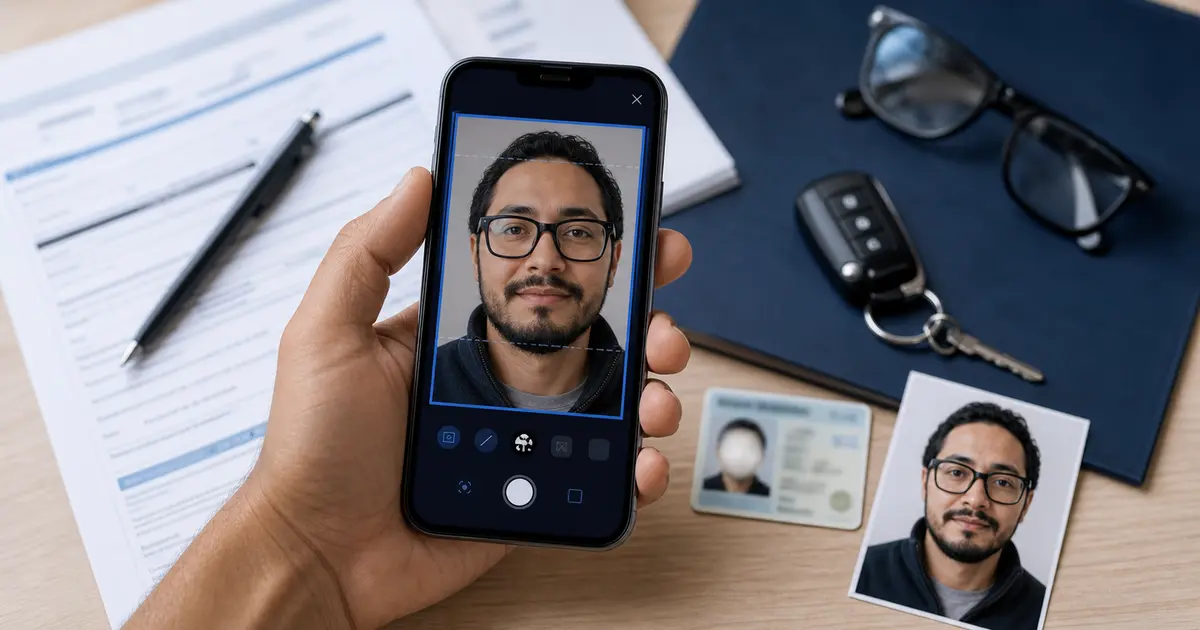

REAL ID Photo (2026): What REAL ID Changes, When DMV Takes the Photo, and When a Passport Still Works
Learn what a REAL ID actually changes, whether REAL ID has special photo rules, when DMVs take the photo themselves, and when a passport or another acceptable ID still works instead.

What people usually mean when they search for “REAL ID photo”
Most users searching for REAL ID photo are really asking one of three things: what a REAL ID is, whether a REAL ID card needs a special photo, and where the photo is taken. The short answer is that REAL ID changes the document standard, not the idea of a passport-style portrait. In practice, the photo is usually handled through the same DMV or driver-license-center workflow that issues the card.
That matters because many users arrive expecting a passport-photo upload flow. For many state ID and licence products, that is the wrong model. A retail print counter, a pharmacy kiosk, or an online photo app may still help with other document workflows, but a REAL ID application often ends with the issuing office taking or approving the image directly.
What REAL ID actually changes
The federal change is about which state-issued IDs count for federal purposes. TSA explains that a REAL ID-compliant driver licence or identification card is required for domestic flights and certain federal facilities unless you carry another acceptable document such as a passport. That means the practical question is often less “How do I make a REAL ID photo?” and more “Do I need a REAL ID card at all, or do I already have another acceptable ID?”
| Question | Short answer |
|---|---|
| Does REAL ID require a different kind of portrait than any other DMV photo? | Usually no. The bigger change is the document standard and application process. |
| Can a passport replace REAL ID for airport security? | Yes. TSA lists a valid passport as an acceptable alternative. |
| Does Passlens replace the DMV photo station for REAL ID? | Usually no. Many REAL ID workflows still end at a DMV or Photo License Center. |
Where the photo usually happens in real ID workflows
The safe default is to assume the issuing authority controls the photo step unless the state explicitly says otherwise. New York DMV tells users to visit a DMV office for a non-driver ID or REAL ID transaction and notes that the permanent card is mailed after the office visit. Pennsylvania’s PennDOT route for a photo ID sends users to a Photo License Center, where the photo is taken for the card. In both cases, the key operational fact is the same: the official office is still the source of truth for the actual card image.
That does not make photo-prep content useless. It changes what the content should do. A good REAL ID page should help users understand the rule set, gather the right documents, and avoid walking into the wrong office with the wrong expectations. It should not pretend that a browser crop tool can replace a DMV capture lane when the state says otherwise.
Two useful examples: Pennsylvania and New York
Pennsylvania says a photo ID card is issued through a Driver License Center and Photo License Center workflow. For REAL ID, PennDOT also explains that the first REAL ID product adds a one-time fee on top of the regular renewal fee, and that some residents may already have documents on file for pre-verification. New York DMV frames REAL ID differently: there is no extra REAL ID fee beyond the normal transaction fee, but users still need to bring the right documents to a DMV office and provide two New York residency proofs for REAL ID or Enhanced ID.
That is exactly why a single national “REAL ID photo” answer is not enough. The federal rule is shared, but the state process is still local. Pennsylvania and New York both route the user through the issuing office. The paperwork, pre-check steps, and fee structure are where the difference shows up.
Best next step if REAL ID is your actual goal
- Check whether you already have another acceptable ID, such as a passport.
- If you do need a REAL ID card, use the state DMV or PennDOT application route first.
- Treat office-capture or Photo License Center instructions as the final rule for the card image.
- Use Passlens for passport, visa, national-ID, and print-layout workflows where a self-prepared image is actually part of the process.