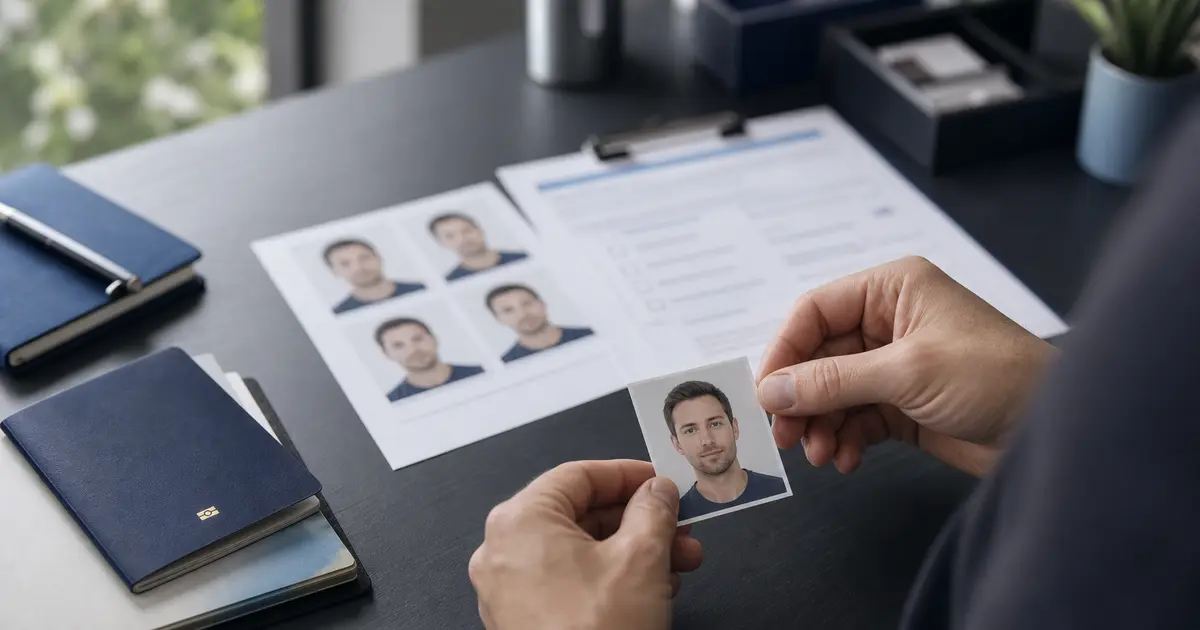

35x45 Photo Size Guide (2026): Biometric Photo 35x45 Rules for Passport, Visa, and ID Workflows
35x45 photo size in inches and pixels: 1.38 x 1.77 inches, about 413 x 531 px at 300 DPI, about 827 x 1063 px at 600 DPI, plus the passport, visa, and ID differences that still matter.
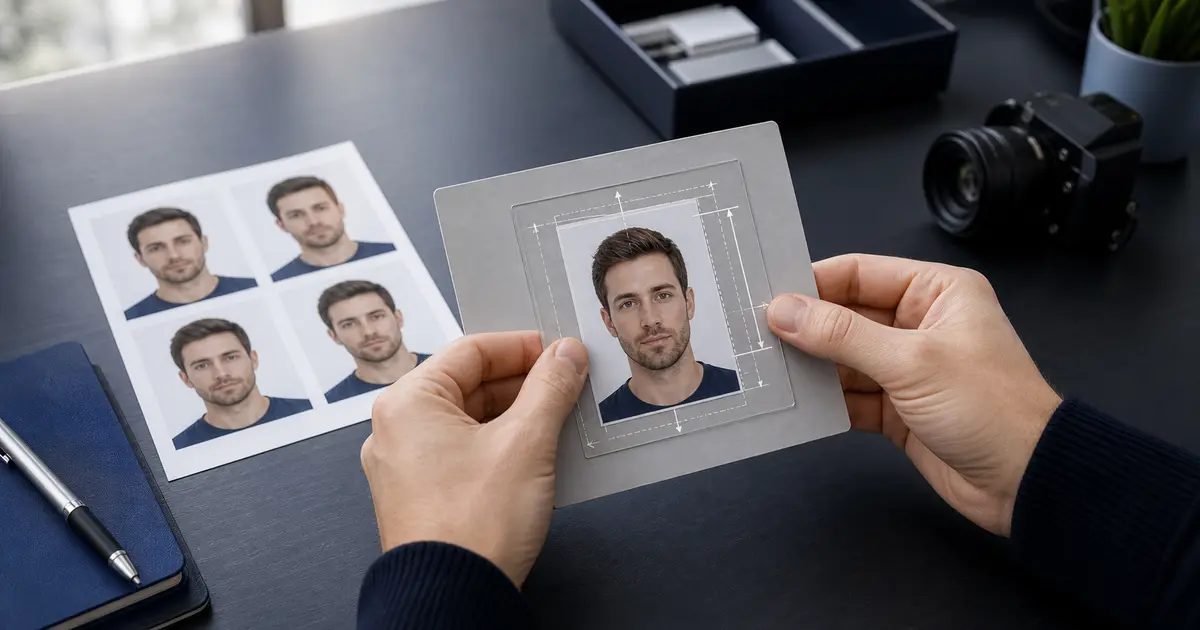
Why 35x45 is one of the most important passport-photo sizes
The 35 × 45 mm format is one of the most widely used document-photo sizes in the world. It appears across many passport, visa, national-ID, and driving-licence workflows, especially in Europe and in countries that use European-style biometric photo standards. That popularity is exactly why people get caught out by it. They assume the shared outer size means the rest of the rule is shared too. It is not.
Two countries can both use 35 × 45 mm and still disagree on background colour, face-height range, glasses, digital upload rules, or whether the workflow is print-first or portal-first. A useful 35×45 guide therefore has to do more than convert millimetres to inches. It has to explain how the shared frame hides different compliance details.
This is also why people searching for biometric photo 35x45 often need a more nuanced answer than a raw conversion table. The phrase usually points to a real compliance family — especially for European passport, Schengen visa, ID-card, and licence routes — but the final rule still depends on the authority handling the application. If your actual target is a short-stay visa, use the Schengen visa photo guide alongside this page so the member-state checklist stays in view.
If you only need the short answer, 35 x 45 mm is about 1.38 x 1.77 inches, about 413 x 531 pixels at 300 DPI, and about 827 x 1063 pixels at 600 DPI. If you want to make or verify the photo now, open the passport photo maker or run it through the passport photo checker before you export.
Simple conversion
35 × 45 mm is about 1.38 × 1.77 inches. At 300 DPI the common digital export is roughly 413 × 531 pixels.
35x45 in millimetres, inches, and pixels
| Format | Width | Height |
|---|---|---|
| Millimetres | 35 mm | 45 mm |
| Inches | 1.38 in | 1.77 in |
| Pixels at 300 DPI | 413 px | 531 px |
| Pixels at 600 DPI | 827 px | 1063 px |
Those pixel conversions are useful for digital preparation, but they do not override the document-specific rules. If an online system accepts a 35×45-style digital photo, it may still require a minimum file size, a maximum upload weight, or a specific JPEG profile. The safest workflow is to start with the correct preset for the country or document and then export from there rather than memorising one pixel pair and reusing it everywhere.
Quick answers for 35x45 size, inches, and pixel searches
Most 35x45 searches are not really asking for a long theory lesson. They are asking whether the size is right, how it converts, and whether the same file can be used for a passport, visa, ID card, or online upload. Use these quick answers first, then check the document-specific guide before you export.
| Search question | Short answer |
|---|---|
| 35 45 mm photo size in inches | 35 x 45 mm is about 1.38 x 1.77 inches. Print from the millimetre size, not a rounded inch estimate. |
| 35x45 in pixels | At 300 DPI it is about 413 x 531 px. At 600 DPI it is about 827 x 1063 px. |
| 35 x 45 mm photo in pixels | The pixel size depends on DPI. For most passport-photo exports, 300 DPI and 600 DPI are the useful reference points. |
| 35x45 aspect ratio | The shape is 7:9 after simplifying 35:45. It is taller than a square 2x2 U.S. photo. |
| 35mm wide by 45mm high in pixels | Use 413 x 531 px at 300 DPI or 827 x 1063 px at 600 DPI if the system asks for a DPI-based export. |
| Is 35x45 passport size? | Yes for many European, UK-style, and biometric workflows. It is not the U.S. 2x2 size, Canada 50x70 size, or China 33x48 size. |
| Schengen visa photo requirements 35x45 mm | 35 x 45 mm is the common Schengen visa-photo frame, but the consulate or visa-centre checklist can still set background, recency, and print rules. |
If you are comparing different passport-photo sizes, read the broader passport photo size guide. If the upload form talks in pixels instead of millimetres, use the passport photo size in pixels guide before exporting. For visa applications, check the Schengen visa photo guide as well, because 35x45 is only the frame.
35x45, 35 x 45, 35*45, or 35/45: the notation means the same size
Search engines show this size in messy forms: 35x45, 35 x 45, 35*45, 35/45, 35 by 45, and 35mm x 45mm. For passport-photo work, those usually mean the same thing: 35 mm wide and 45 mm high.
| Search wording | Read it as | What to avoid |
|---|---|---|
| 35x45 / 35 x 45 / 35×45 | 35 mm wide by 45 mm high | Do not read it as inches unless the page explicitly says inches. |
| 35*45 mm photo | The asterisk is just another way users type “by” or “x”. | Do not print a 35 x 45 pixel image. This is a millimetre size. |
| 35/45 photo size | Usually the same 35 mm by 45 mm passport-photo format. | Do not treat the slash as an aspect-ratio instruction. |
| 35mm x 45mm passport photo | A portrait document photo, not a landscape image. | Do not swap the values unless the authority specifically asks for a landscape format. |
| 45mm x 35mm passport photo | Usually a reversed search for the same portrait format. | Most passport and visa workflows expect 35 wide x 45 high, not 45 wide x 35 high. |
The safest mental model is width first, height second. A normal 35x45 passport photo is a vertical portrait. If an upload page asks for pixels, convert the portrait shape from the millimetre size instead of rotating the frame.
Which countries and documents use 35x45 photos
The 35×45 format is common in the UK, Germany, France, the Netherlands, Australia, Japan, Singapore, and several other markets. It is also widely used across ID-card and licence workflows that inherit a biometric-style portrait format. But “common” should not be confused with “identical.” The UK often accepts light grey or cream backgrounds in passport-style images. France is stricter about white backgrounds. German biometric-photo expectations are tightly framed. Singapore expects a white background for some ICA workflows.
| Workflow | Outer size | What still varies |
|---|---|---|
| UK passport | 35 × 45 mm | Background tone and online checker expectations |
| Germany passport / ID | 35 × 45 mm | Biometric centring and head-height rules |
| France passport / ID | 35 × 45 mm | Background colour and identity-photo standards |
| Netherlands passport / ID | 35 × 45 mm | Face size guidance and composition |
| Japan passport | 35 × 45 mm | Head placement and print / upload handling |
| Singapore passport / ID | 35 × 45 mm | White-background requirement and ICA-specific expectations |
What people usually mean by “biometric photo 35x45”
In search terms, “biometric photo 35x45” usually means a document portrait that follows the familiar European-style biometric framing: front-facing head position, clear facial visibility, plain background, and a measurable face range inside a 35 × 45 mm outer frame. That wording is useful, but it is still only a family label. The exact enforcement changes by authority.
That is why some 35×45 workflows feel similar without being interchangeable. A French identity photo, a German passport photo, an Irish passport photo, and a Polish Schengen visa photo can all look like members of the same biometric family while still differing on white versus light neutral background wording, the way the face range is described, and whether the submission stays print-first or moves into a digital portal.
What varies even when the outer size stays 35x45
The first variable is background colour. Users often assume a 35×45 biometric photo must always be plain white. That is wrong. France is the classic counterexample because some French identity workflows reject pure white in favour of a very light grey or blue-grey tone. The UK often allows neutral light backgrounds. Germany wants a uniform light background. Singapore passport and ID workflows often point users back to a white-background rule. Same size, different background expectations.
The second variable is head size. An image can be exactly 35 × 45 mm and still be rejected because the face is too small or too large for the issuing authority’s preferred biometric framing. That is why manual cropping by eye is risky even when you know the outer size.
The third variable is submission mode. Some 35×45 workflows are primarily print based, while others are increasingly portal driven. A digital application may therefore have extra image-upload rules beyond the physical frame. A good guide needs to mention that instead of acting as though all 35×45 workflows end at a printed photo.
Digital upload versus printed 35x45 photos
A 35×45 photo can describe either a printed photograph or the physical template behind a digital upload. That distinction matters because users often solve the wrong problem. If the authority wants a printed photo, the key risks are print scale, paper quality, and measured outer size. If the authority wants a digital upload, the key risks are pixel dimensions, file-size limits, and whether the portal checks the background and face automatically.
This is why a useful 35×45 guide has to talk about the output mode as well as the format. The same outer size can lead to very different export decisions depending on whether the final destination is a print lab, a home printer, or a passport website.
Why 35x45 matters so much for Schengen visa applications
The strongest real-world 35×45 search intent is often Schengen visa photography. Many member-state consular and visa-centre checklists still converge on a recent 35 × 45 mm biometric photo with a white or very light background. The broad Schengen framework points users toward ICAO-compliant photographs; the member-state checklist is where the exact operational wording appears.
This is why the Schengen visa photo guide belongs next to this size guide. This page explains the format family. The Schengen page explains how that family is actually enforced through member-state and consular checklist language.
What people get wrong about 35x45 photos
- Assuming all 35×45 countries allow the same background colour.
- Reusing a passport crop for a national ID or licence without checking head-height rules.
- Using the right millimetre size but the wrong digital export for an online portal.
- Printing with fit-to-page enabled and silently changing the physical size.
- Treating a shared format as proof that the whole workflow is shared.
Safe rule
Use the 35×45 guide to understand the format, then switch to the exact country or document preset before exporting.
A practical check before you export
Before exporting, confirm three things together: the outer size is truly 35 × 45 mm, the face looks proportionate for the target document, and the background rule matches the country guide you are following. That small review step catches many of the mistakes that happen when people treat 35×45 as a universal template instead of a format with document-specific variations.
If one of those checks is still unclear, stop and switch to the exact country or document page. A broad size guide should help you orient yourself, but the final export should still come from the most specific rule set you have.
Create a 35x45 photo with the correct preset
Passlens can generate a 35×45 photo for the exact passport, visa, ID, or licence workflow you need. The important step is choosing the real document preset so the crop, background guidance, and export mode reflect the authority you are actually applying through.
Treat the 35×45 format as the frame, not as the whole answer. The compliant result comes from matching that frame to the right country, document, and submission path.