
Schengen Visa Photo Requirements 2026: Official 35 x 45 mm Checklist, VFS Checks, and Free Maker
Check Schengen visa photo requirements for 2026: official 35 x 45 mm checklist, white or light background, one or two printed photos, VFS or consulate checks, and a free maker workflow.
Why Schengen visa photo rules need their own guide
People often search for a single set of Schengen visa photo requirements as if there were one central photo specification page that covers every consulate. In practice, that is not how the workflow works. The European Commission sets the broad application framework and requires a photo in compliance with ICAO standards, but the exact document checklist usually comes from the member-state consulate, visa centre, or official visa partner. That is why a good Schengen page has to do two things at once: explain the strong common pattern and show where state-level checklists still matter.
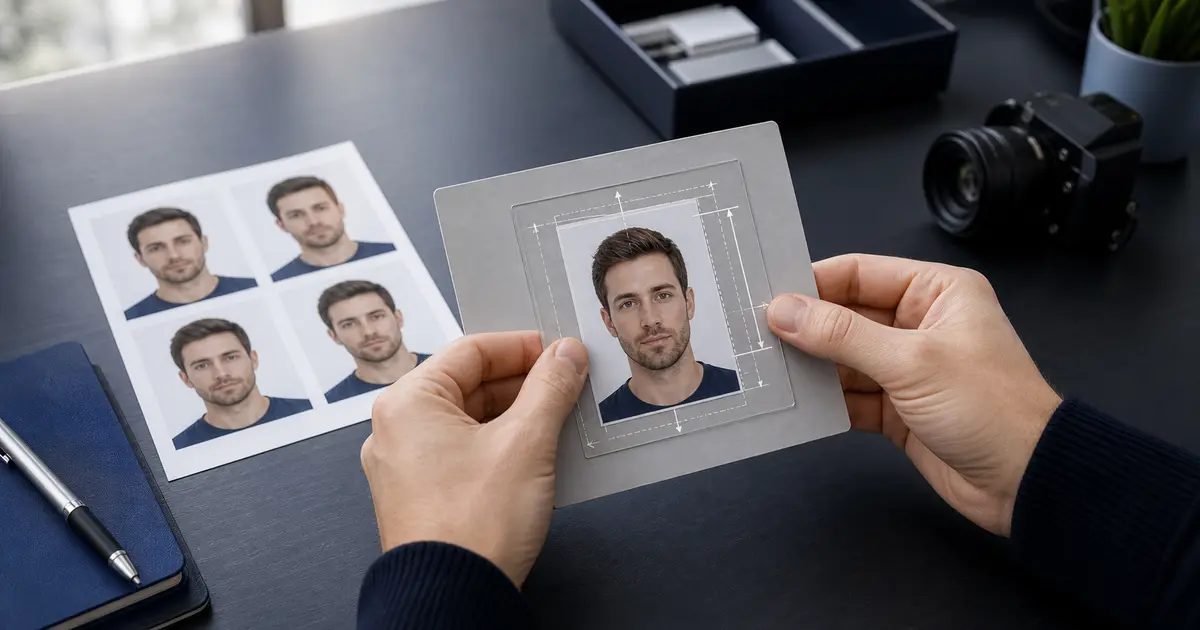
The common pattern is real. Across many short-stay Schengen visa routes, the expected photograph is a recent 35 × 45 mm biometric-style portrait, usually on a plain white or light background, taken within the last six months. But you should still verify whether your specific consulate asks for one or two printed photos, whether it explicitly says white rather than light neutral, and whether the application centre may rescan or reject a low-quality print even if the crop itself is correct.
If you only need the short answer, a Schengen visa photo is usually a recent 35 x 45 mm biometric print on a white or light plain background. Many consular checklists ask for one printed photo, some ask for two, and the member-state source still decides the final wording.
Safe starting point
Treat “Schengen visa photo” as a member-state consular checklist built on ICAO norms, not as one universal Europe-wide print template. The member-state checklist still wins.
Quick answers for Schengen visa photo searches
Most Schengen photo searches are really asking for one of four things: the common 35 x 45 mm print size, whether the photo has to follow ICAO-style biometric rules, how many printed copies to bring, or whether a country-specific visa checklist overrides a broad Europe answer. Start with the table below, then open the member-state page for the country processing the application.
| Search phrase | Short answer | Next page |
|---|---|---|
| Schengen visa photo requirements 2026 | Prepare a recent ICAO-style biometric photo. Many consular checklists use a 35 x 45 mm print, but the exact copy count and background wording come from the member-state checklist. | See the common Schengen pattern |
| Schengen visa photo 35 x 45 mm official | 35 x 45 mm is the clearest common print frame in many official member-state examples, including Polish and Italian checklist wording. | Check 35x45 mm size and pixels |
| Schengen visa photo 35 x 45 mm official checklist | Use a recent biometric 35 x 45 mm print, then compare copy count, background wording, and appointment-centre handling against the exact member-state source. | Use the appointment checklist |
| Europe visa photo size / EU visa photo size | There is no single EU-wide photo-size page for every visa route. Short-stay Schengen routes often use 35 x 45 mm, while national visas and appointment centres can add their own instructions. | Compare visa photo sizes by country |
| Passport size photo for Schengen visa | Do not use a generic passport-size print from another country. Use the Schengen member-state checklist, then export at the exact physical size required. | Compare passport-photo sizes |
| How many photos for Schengen visa | One photo is common in some official checklists, but some centres or appointment packs can ask for two. Check the consulate or visa-centre checklist before printing. | See what still varies |
| ICAO passport photo standards 2026 | The European Commission asks for a photo that complies with ICAO standards; country checklists translate that into size, background, recency, and print-quality wording. | Read official member-state examples |
| France Schengen visa photo requirements 2026 | France-Visas focuses on ICAO-style photograph quality and 70-80 percent face coverage. Use the France page if France is processing the visa. | Open the France visa photo guide |
| Germany, Italy, Spain, Netherlands, or Poland visa photo size | Those are not separate Europe-wide answers. Open the country page because the consulate checklist controls background, copy count, appointment handling, and print wording. | Start from the country size table |
What most Schengen consular photo checklists have in common
| Requirement area | Typical Schengen pattern | Why it matters |
|---|---|---|
| Outer size | 35 × 45 mm | This is the most common short-stay visa print format across member-state checklists |
| Photo style | ICAO-compliant biometric portrait | Front-facing image, neutral expression, and clear face visibility |
| Background | White or light plain background | State wording varies even when the photo frame is the same |
| Recency | Usually no more than 6 months old | Old photos are a frequent checklist failure |
| Print quality | Sharp colour print, no scans or photocopies | Consulates and VACs often reject low-quality reproductions |
The broad Schengen application guidance from the European Commission still keeps things high level: it asks for a photo in compliance with ICAO standards. The member-state checklist is where that broad rule becomes usable. France-Visas publishes a dedicated ICAO-style photograph specification sheet. Polish consular checklists make the 35 × 45 mm size explicit and tie it directly to ICAO guidance. Italian consular checklists commonly restate the same pattern with a recent 35 × 45 mm colour photo on a white background.
Schengen visa photo 35 x 45 mm official checklist before your appointment
This is the practical pre-appointment checklist for Schengen visa photo 35 x 45 mm official checklist searches. It is not a substitute for the consulate page, but it turns the official pattern into the checks you can run before you travel to the appointment centre.
| Check | What to prepare | Why it matters |
|---|---|---|
| Size | 35 x 45 mm printed photo unless your member-state checklist says otherwise. | The page needs to answer the exact size query in the first screen. |
| Copy count | Bring the required one or two printed photos from the member-state or visa-centre checklist. | Users search this right before booking or attending an appointment. |
| Background | Plain white or light background with no texture, wall line, or strong shadow. | Background wording varies, so the page must give the common pattern and the source check. |
| Face and pose | Front-facing, neutral expression, clear eyes, no heavy retouching, no tilted head. | These are visible rejection risks users can fix before printing. |
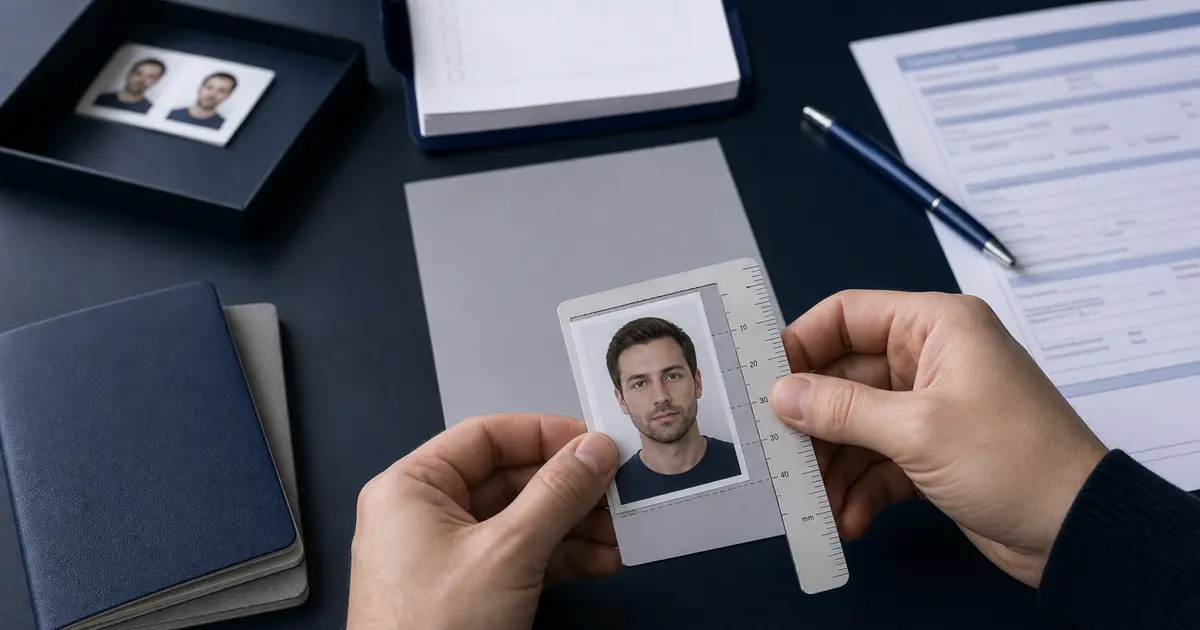
| Print scale | Print at 100% scale. Do not use fit-to-page, shrink-to-fit, or borderless auto-scaling. | A correct crop can fail if the physical print is resized by the print dialog. |
| Appointment handling | Expect VFS or consulate appointment checks to inspect the print, and sometimes rescan or request a new copy. | This matches the user’s real workflow after the web search. |
The safest reading is simple: 35 x 45 mm is the common Schengen print frame, but the member-state checklist still wins. If France, Germany, Italy, Spain, the Netherlands, or Poland is handling the file, use that country’s page before printing.
What gets rejected at the visa appointment
VFS or consulate appointment checks are usually less forgiving than an online preview. The print has to be the right size, recent, clear, and compatible with the authority’s checklist. A photo that looks fine on screen can still fail when it is measured, scanned, or compared with the application pack.
- Wrong physical size: the image was prepared as 35 x 45 mm but printed smaller or larger because the sheet was scaled.
- Old or reused photo: the checklist asks for a recent image and the print clearly looks reused from an older passport, visa, or ID.
- Weak background: the wall is grey, patterned, shadowed, or visibly edited around hair and shoulders.
- Low-quality print: the photo is soft, banded, pixelated, scanned, photocopied, or printed on unsuitable paper.
- Country mismatch: the applicant brought a generic passport-size print instead of the Schengen member-state checklist size.
Before you leave
Measure the print, check the background in daylight, and keep the official country checklist open. The appointment clerk does not care which generic Schengen article you used.
What official member-state sources say
| Source family | What it states | Operational takeaway |
|---|---|---|
| France-Visas | ICAO-format photograph with dedicated quality guidance | Use a compliant biometric crop and be careful with the portrait proportions beyond the outer size |
| Polish Schengen visa checklist (gov.pl) | One biometric passport-type colour photo, 35 mm × 45 mm, white background, less than 6 months old | This is one of the clearest official examples of the common Schengen 35x45 pattern |
| Italian consular tourism visa checklist | Recent passport-size photograph, 35 mm × 45 mm, white background, full face, front view | Italy confirms the same core pattern and adds strong print-quality expectations |
Those examples show why it is misleading to tell users “Schengen visa photos are all identical.” They are similar enough to justify a dedicated guide, but the working rule is still consulate first. The outer size converges around 35 × 45 mm; the detailed handling comes from the specific member state processing your application.
If France is the member state processing your application, use the France visa photo requirements guide next. It keeps the Schengen 35 x 45 mm pattern tied to France-Visas quality guidance and appointment-centre checks.
What still varies between Schengen consulates
- How many photos are required: one photo is common, but some centres or checklist variants ask for multiple copies.
- Background wording: some sources say white; others say plain light background or refer users back to ICAO quality sheets.
- Submission handling: some visa centres will scan your printed application pack, while others may offer on-site photos if yours fail.
- Checklist packaging: some member states put the photo rule on a tourism/family checklist, while others bury it in a general application-form note.
- Print quality emphasis: scanned or photocopied photos are often rejected even when the measurements are right.
That variation is why the safest workflow is to prepare a strong 35 × 45 mm biometric photo, then compare it against the exact consular checklist before printing or attaching it. If the consulate page is vague, check whether it links out to a member-state visa centre or a dedicated photograph-quality PDF before you assume the background or copy count.
Printed Schengen visa photos versus digital visa uploads
A lot of Schengen short-stay traffic still starts from a printed photo attached to a form or carried to a visa appointment. That is different from U.S.-style DS-160 upload flows or online renewal portals that define the file in pixels first. If your Schengen route still expects a physical photograph, the main risks are: wrong physical size, weak print quality, and scaled printing. If the appointment centre digitises your file later, that does not mean you should start from a generic upload template.
This is also why digital upload advice and a 35x45 biometric print guide should stay connected but distinct. One solves portal constraints. The other solves consular print compliance.
Where Schengen visa applicants usually go wrong
- Using a country-specific passport photo from another market and assuming it automatically fits a Schengen visa checklist.
- Printing a correct 35x45 crop with fit-to-page enabled, which silently changes the outer size.
- Bringing a scan or photocopy instead of a sharp colour print.
- Assuming a pure white background is always required without checking the exact consular wording.
- Using a generic Europe visa article that never names the actual member-state authority.
Practical rule
If your destination is in the Schengen area, identify the exact member-state consulate first. Then validate the photo against its checklist rather than the generic Schengen label.
Free Schengen visa photo maker: prepare the 35 x 45 mm print in Passlens
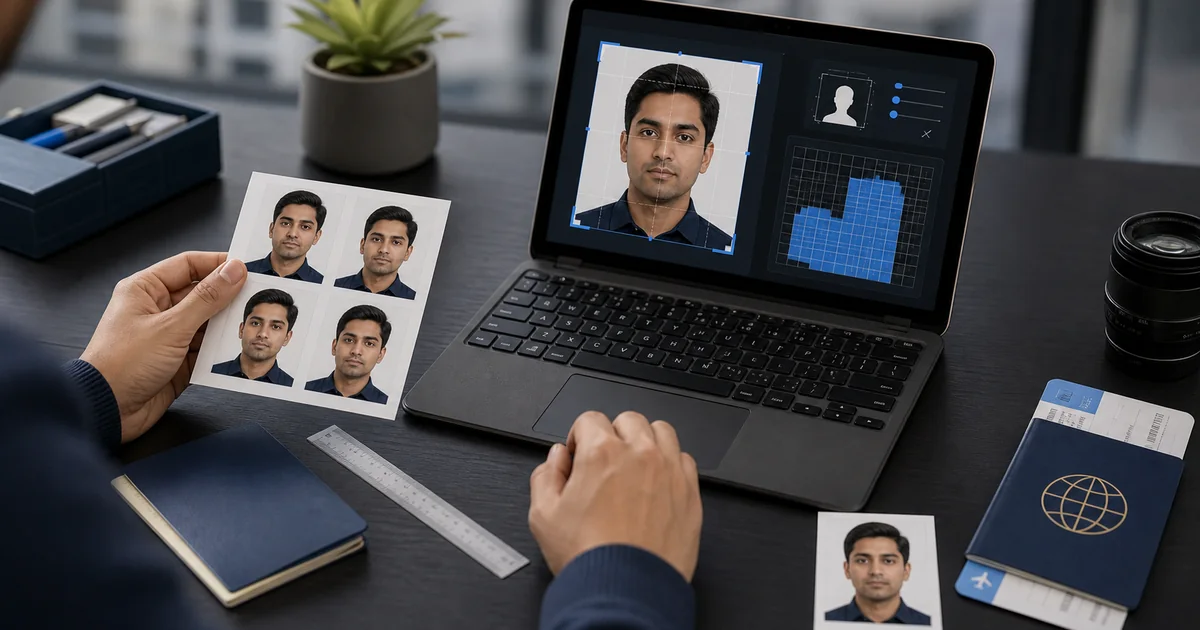
Use Passlens as a Free Schengen visa photo maker when you need a measured 35 x 45 mm biometric crop before a VFS or consulate appointment. Start in the browser editor, choose a 35 x 45 mm preset, check the background, then generate a print sheet. Print at 100% scale so the physical photo stays the same size as the export.
Passlens is useful here because it lets you prepare the crop, run a visual check with the passport photo checker, and send the result to a measured print layout without switching between a generic resize tool and a consular checklist. The final validation step still belongs to the exact member-state source, but the photo preparation workflow does not need to be improvised.