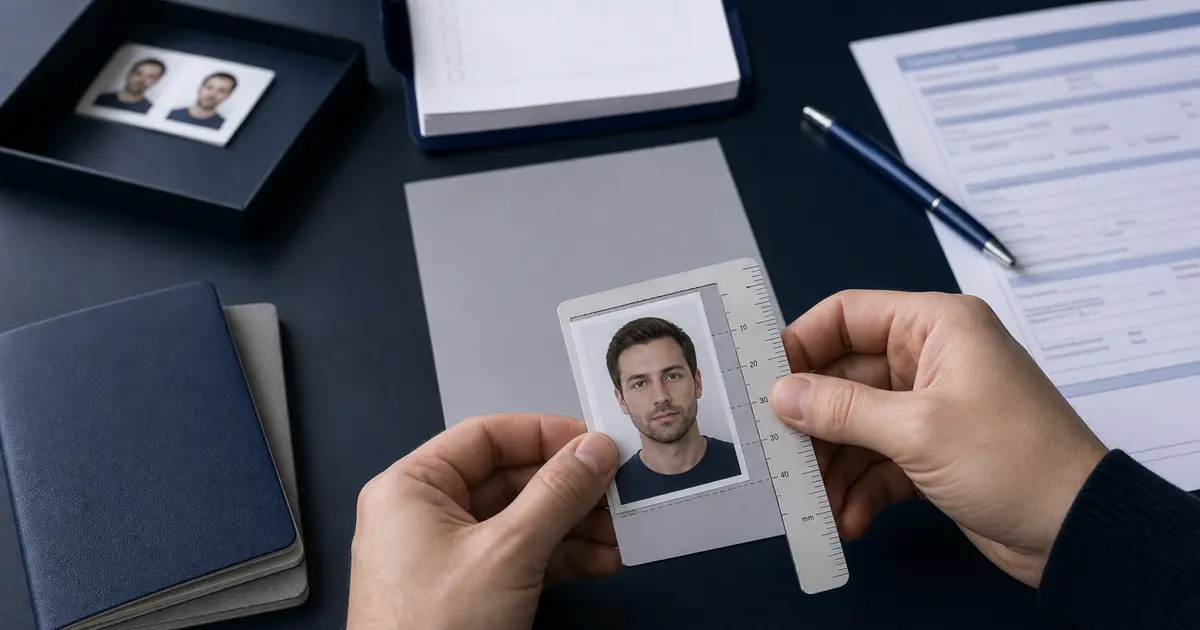

German Passport Photo Requirements 2026: 35x45 mm Biometric Passbild, Light Grey Background
German passport photo requirements for 2026: 35x45 mm biometric Passbild, 32-36 mm adult face zone, preferably light-grey background, and the digital authority photo route from 1 May 2025.

Fast answer: German passport photo requirements
For a German passport photo, use a 35 x 45 mm biometric Passbild. For adults, the face should sit in the 32-36 mm zone from chin to crown. The background should be plain and preferably light grey. Keep the head straight, eyes visible, mouth closed, and expression neutral.
The size is only half of the German rule. Since 1 May 2025, the normal Reisepass and Personalausweis route uses digital biometric photos taken at the authority or sent by an approved photo service through the cloud workflow. Use Passlens to check the crop and background before you follow the Bürgeramt or provider route.
| Search question | Short answer | Next step |
|---|---|---|
| German passport photo requirements | 35 x 45 mm biometric Passbild, adult face 32-36 mm, plain preferably light-grey background. | Check the crop, then follow the authority or approved photo-provider route. |
| Germany passport photo size 35 x 45 mm official | The outer frame is 35 x 45 mm. Do not resize from rounded inches if you can export the exact millimeter size. | Check 35x45 mm size math |
| Biometrisches Passfoto Anforderungen Deutschland 2026 | Germany still uses the classic biometric frame, but the normal passport and ID handoff is now digital. | Read the digital submission notes |
| German passport photo background color | Use a plain background that is preferably light grey, with no shadows, texture, or objects. | Compare passport background colors |
| German visa photo size 2026 | German visa-photo searches usually point to a 35 x 45 mm biometric frame, but the consulate route can differ. | Open the Germany visa photo guide |
Overview
Germany requires a biometric passport photo (Passbild) measuring 35 x 45 mm for identity documents such as the Reisepass (passport) and Personalausweis (national ID card). The familiar biometric frame is still in place, but the application workflow changed materially in 2025: for the main document types, authorities now expect a digital biometric photo workflow rather than the old printed-photo default.
The latest official lightbild template published by the BMI/Bundesdruckerei keeps the classic biometric checks: 35 x 45 mm, a face height in the 32–36 mm range for adults, eyes clearly visible, head held straight, even lighting, and a plain background that is preferably light grey. The key practical change is that from 1 May 2025, German authorities moved the normal passport and ID route to digital-only lightbilder captured at the authority or transferred by an approved photo service provider via cloud delivery.
If you landed here searching for passport photo requirements rather than only Passbild, Germany is a strong example of why the broad phrase needs country context. The outer size looks familiar across Europe, but Germany combines the 35 x 45 mm biometric frame with a preferred light-grey background and a digital-only authority workflow that is different from France, Ireland, Italy, or the UK.
The short answer to Germany passport photo requirements 2026 is this: use a 35 x 45 mm biometric crop, keep the adult face in the 32-36 mm zone, use a plain background that is preferably light grey, and treat the final authority handoff as a digital-only workflow for the main passport and ID routes.
If you only need the short answer, Germany uses a 35 x 45 mm biometric photo with a 32-36 mm adult face zone, a preferably light-grey background, and the digital-only authority route from 1 May 2025. If you are ready to make the file now, open the Germany passport preset in Passlens and then compare the result with the official guidance below.
That also answers looser searches like German passport photo requirements, German passport photo size, German passport size photo, German passport picture size, or Reisepass Größe Deutschland. The practical rule set is still the familiar 35 x 45 mm biometric Passbild, but Germany layers on a light-grey background preference and the newer digital authority workflow.
In German search, the wording often gets even more explicit: Reisepass Größe Deutschland or Passbild Anforderungen Deutschland 2026 biometrisches Passfoto. Those searches are usually not looking for a second format. They are looking for confirmation that Germany still uses the classic 35 x 45 mm biometric Passbild, together with the light-grey background preference and the current digital handoff to the authority.
Quick answers for German biometric photo searches
Most Germany photo searches are asking for the same core rule in different words: 35 x 45 mm, biometric framing, straight head position, visible eyes, neutral expression, and a plain background that is preferably light grey. The table below maps the common English and German searches to the right next step.
| Search phrase | Short answer | Next page |
|---|---|---|
| Germany passport photo size 35 x 45 mm official | Germany uses a 35 x 45 mm biometric photo frame for passport and ID workflows. | Check 35x45 mm size math |
| Biometric passport photo requirements Germany 2026 | Use a frontal biometric photo with visible eyes, neutral expression, even lighting, and the adult face in the 32-36 mm zone. | Compare passport requirements by country |
| Biometrisches Passbild Anforderungen Deutschland 2026 | A German biometric Passbild is still 35 x 45 mm, but the normal authority handoff is now digital for the main passport and ID routes. | Read the digital submission notes |
| Passbild Format / Passfoto Format Deutschland | For Reisepass and Personalausweis routes, the photo format is 35 x 45 mm. The passport booklet format is a separate issue. | See the Passbild size section |
| German biometric passport photo neutral expression | Keep the face straight, mouth closed, expression neutral, and both eyes clearly visible. A smile is risky because the biometric template expects a neutral face. | Check appearance rules |
| German visa photo size 2026 | German visa-photo searches usually point to the same 35 x 45 mm biometric frame, but visa applicants should still check the embassy or consulate route. | Open the Germany visa photo guide |
| German residence permit photo requirements | Residence-permit photo routes often reuse the biometric frame, but the authority workflow can differ from a passport appointment. | Compare residence permit photo rules |
| Ausweis photo size / Personalausweis Foto Größe | The German ID card route uses the same 35 x 45 mm biometric photo frame. | Open the Germany ID card photo guide |
German Passbild size explained
A common search is German passport photo size, German passport size photo, or Passbild anforderungen. For passports and most German identity documents, the print-equivalent biometric frame is still 35 x 45 mm, with a face height of roughly 32–36 mm for adults inside the frame.
That means you still need both the correct outer dimensions and the correct biometric crop. A photo can be exactly 35 x 45 mm and still fail if the face height, eye line, head position, or background contrast is wrong. The digital-only rollout did not relax the biometric rules; it simply changed how the photo reaches the authority.
If you are comparing Germany with other countries that also use 35 x 45 mm, start with the passport photo requirements by country guide. It helps explain why the same outer dimensions can still produce different background, head-height, and submission requirements.
Passbild Anforderungen Deutschland 2026 checklist
- Use the biometric frame: 35 x 45 mm with the adult face kept in the 32-36 mm zone.
- Keep the head straight: no tilt, no rotation, both eyes visible and level.
- Prefer a light-grey background: plain, even, and shadow-free rather than bright white by default.
- Prepare for the digital-only route: the main Reisepass and Personalausweis workflows now expect the official digital lightbild path.
- Check eye visibility carefully: glare, hair, or heavy frames can still break an otherwise correct biometric crop.
- Treat prints as secondary: a good print-equivalent crop is still useful, but the actual authority handoff is now the bigger workflow question.
That checklist is the practical answer behind searches for passport photo requirements and Passbild Anforderungen Deutschland 2026 biometrisches Passfoto. Germany is not difficult because the outer size is unusual. It is difficult because the biometric crop and the authority delivery route must both be correct at the same time.
Official specifications
| Requirement | Value |
|---|---|
| Document | Passport |
| Size | 35 × 45 mm |
| Background | Light / neutral |
| Head height | 32–36 mm |
| Note | Uniform light background (neutral grey preferred). |
The photo must be exactly 35 mm wide and 45 mm tall. The face height from chin to the top of the head falls in the 32–36 mm zone for adults in the official lightbild template. Eyes must be open and clearly visible, the nose should stay within the central zone, and the head must be straight and frontal.
| Specification | Requirement |
|---|---|
| Photo size | 35 x 45 mm |
| Face height (chin to crown) | 32–36 mm |
| Background | Uniform, preferably light grey |
| Color | Colour for digital submissions |
| Recency | Use a recent current-appearance photo |
| Biometric | Frontal, straight head, neutral expression |
| Delivery workflow | Digital-only for the main passport and ID routes from 1 May 2025 |
Background requirements
The official German lightbild template says the background should be plain and preferably light grey. That is slightly different from countries that strongly prefer white. The real requirement is an even, one-colour background with strong facial separation and no visible texture or objects.
The background must be completely uniform with no gradients, patterns, or shadows. German biometric checks are particularly sensitive to uneven lighting, so a technically correct crop can still fail when the background brightness changes from one side of the frame to the other.
If you are trying to decide whether a white backdrop is acceptable, use the passport photo background color guide together with this country page. Germany is one of the clearest examples where a generic “white background for every passport” assumption is weaker than the actual official guidance.
Grey matters in Germany
Germany is one of the clearer examples of why passport-photo background advice cannot be generalized country to country. A white background can work elsewhere, but the German template explicitly says the preferred standard is light grey.
Clothing and appearance
Germany’s biometric requirements are very precise. The face must be perfectly frontal with a neutral expression. The mouth should be closed, the eyes should be clearly visible, and the head cannot be tilted, rotated, or tipped.
- Glasses: The official German template does not frame this as a blanket ban. The safe interpretation is that the eyes must stay clearly visible, unobscured, and free from glare or heavy reflections. Many applicants remove glasses to reduce rejection risk.
- Head coverings: Only permitted for documented reasons, with the full face still visible.
- Expression: Neutral, with lips closed.
- Head position: Straight, frontal, and centered in the frame.
- Eyes: Open, clearly visible, and approximately level with each other.
- Shadows: No facial or background shadows.
How to prepare the photo with Passlens
Passlens is useful for preparing the biometric crop itself: the 35 x 45 mm frame, adult face-height target, straight head position, and plain background. That makes it easier to prepare a compliant-looking source image before you move to the actual submission route.
- Open Passlens and select the Germany Passport preset.
- Take or upload a sharp, evenly lit frontal photo.
- Check the biometric crop, eye visibility, head centering, and neutral expression.
- Use background cleanup to reach the preferred plain light-grey look.
- Use the export as a preparation step, then confirm whether your authority requires a digital transfer route instead of any paper submission.
How the submission workflow changed
German passport and ID applications are processed at local Bürgeramt or related authority offices. Since 1 May 2025, the main path for Reisepass, Personalausweis, and versions of the electronic residence permit uses digital-only biometric photos captured at the authority itself or supplied by a photo provider through the approved cloud workflow.
That workflow change is the part many people miss when they search for a simple German passport photo size. The biometric photo itself still looks like a classic 35 x 45 mm Passbild, but the authority increasingly expects the image to arrive through the approved digital route instead of the old print-first hand-in model.
- In person (Bürgeramt): Expect the authority to use a digital biometric photo route for passports and ID cards.
- Photo service transfer: Approved providers can deliver the lightbild digitally through the official cloud workflow.
- Paper photos: The official template still helps with paper-based evaluation only where printed photos remain allowed or in exceptional cases.
If you want to compare that with other 35 x 45 mm countries that still have more obvious print-facing routes, keep the Ireland passport photo guide and the France passport photo guide nearby. The shared frame is similar, but the submission logic is not.
Common mistakes
- Head tilted or rotated — Even slight tilt can fail the biometric check.
- Eye visibility problems — Frames, glare, reflections, hair, or shadow that partially hide the eyes are all rejection risks.
- Incorrect face height — The 32–36 mm range is tightly enforced for adults.
- Shadows on face — German requirements are especially strict about even lighting.
- Wrong background — Dark, patterned, or coloured backgrounds are rejected. A plain light-grey background is preferred.
- Mouth open or smiling — Any expression other than neutral is risky.
- Bringing only a print — For the main German passport and ID routes after 1 May 2025, the authority expects a digital-only photo workflow.
Frequently asked questions
What are the Germany passport photo requirements for 2026?
Use a 35 x 45 mm biometric photo with a straight head, visible eyes, even lighting, and a background that is preferably light grey. For the main passport and ID workflows, the practical submission path is now the digital-only lightbild route rather than the old print-first assumption.
Can I take my own biometric Passbild at home?
You can prepare the biometric crop yourself, but for the main German passport and ID workflows you still need to confirm how the photo is delivered to the authority. Since 1 May 2025, the core route is digital-only rather than the old print-first workflow.
Is the same photo used for Reisepass and Personalausweis?
Yes, both documents use the same 35 x 45 mm biometric photo specification. The delivery workflow is the part that changed most in 2025, not the biometric frame itself.
Does Germany prefer grey or white?
The official template says the background should be plain and preferably light grey. That makes Germany different from many countries that default to white.
What are the current Passbild Anforderungen in Deutschland for 2026?
For the main passport and ID workflows, the current Passbild Anforderungen Deutschland 2026 still mean a 35 x 45 mm biometric photo with a straight head, visible eyes, even lighting, and a plain background that is preferably light grey. The important workflow change is that the usual authority route is now digital-only rather than a print-first submission.
Can I still bring printed passport photos to a German passport appointment?
For the main German passport and ID workflows, you should assume the authority expects the digital-only lightbild route. Printed photos are now secondary and mainly useful for exceptional cases or for understanding the biometric crop. The safe approach is to check your Bürgeramt instructions rather than relying on the old paper-photo assumption.